08.05.2026
- News & Press Releases
A fairer return for what farmers grow - and for what they restore
Incofin and the CGIAR Hub for Sustainable Finance (ImpactSF) are partnering to bring science-backed Payments for Ecosystem Services to smallholder coffee farmers in Latin America. The first two pilots are now live in Colombia and Nicaragua.

Fairtrade began with a simple truth: farmers deserve fairness. A fair price, a fair chance, a fair future. That promise still stands. But today, fairness means more than price.
A coffee farmer’s job goes well beyond growing coffee. Smallholder producers also hold together the soils, watersheds, and biodiversity that the rest of us depend on. They get paid for the coffee. The rest, largely, is unpaid work.
That gap – between the environmental value smallholders create and the income they take home – is one piece of a larger problem. In most coffee-growing regions, the price of coffee alone does not cover what farmers and their families need to live well. A fair future for smallholder farmers will require multiple income streams working in parallel: fair prices, premiums for sustainable production, and recognition for the ecosystem services they already provide.
The Fairtrade Access Fund (“the Fund”) was built to make that fairer future real. For 14 years, the Fund has financed Fairtrade-aligned cooperatives, producer organisations and agri-enterprises. It has helped them build the resilience they need to keep delivering on Fairtrade’s promise as the climate, regulations and markets around them shift. Payments for Ecosystem Services (PES) are the next layer of that work.
The idea is straightforward. The execution is not. PES markets are fragmented, often small-scale, and hard for individual farmers to access. Without credible measurement systems, environmental claims don’t travel. Without long-term financing, agri-SMEs can’t invest in the transition with practices that make the claims real in the first place.
The CompensACTION initiative of the German Federal Ministry for Economic Cooperation and Development (BMZ) addresses that challenge. As a CompensACTION partner and investor, KfW Development Bank (KfW) supports the Fund and its technical assistance facility advised by Incofin. On the ground, Incofin works in partnership with the CGIAR Hub for Sustainable Finance to combine long-term, impact-linked financing with independent technical assistance – so smallholder contributions to soil, carbon, water and biodiversity can be measured, recognised, and connected to PES markets over time.
In 2025, the first USD 5 million was deployed to two coffee value chain partners: Equation Coffee in Colombia and Aldea Coffee in Nicaragua.
CompensACTION exists because climate goals and smallholder livelihoods have to be addressed together. We were looking for a partner with the financial infrastructure to channel long-term capital into agricultural value chains, and the technical credibility to build real pathways to ecosystem service markets. Incofin's approach – combining long-term financing, impact-linked incentives and rigorous measurement with CGIAR - fits that ambition.
 Lars ZimmermanPrincipal Portfolio Manager - Equity & Fund Investments, KfW Development Bank
How the model works
CompensACTION, carried out through the Fairtrade Access Fund, is built around five pillars – soil regeneration, greenhouse gas emissions and circularity, water use and conservation, biodiversity, and sustainable livelihoods. The Fund provides the long-term financing that lets an agri-enterprise or producer organisation invest in regenerative practice at scale. The loan carries a commercial interest rate, with rebates tied to verified parameters: if the environmental and social outcomes materialise and are independently measured, the effective cost of capital comes down.
Companies that deliver verified outcomes can benefit from interest-rate rebates – an instrument designed to derisk the upfront investment in innovation and to share the upside of impact with the farmer.
Alongside the loan, Incofin supports a dedicated technical assistance component – delivered in partnership with CGIAR. The work establishes environmental baselines, strengthens Monitoring, Reporting and Verification (MRV) systems, and builds a sustainability roadmap that prepares each investee for relevant ecosystem-service opportunities. CGIAR’s role is to bring the scientific rigour that makes MRV credible. It keeps the measurement work independent of the financier and the farmer.
Transforming agricultural value chains starts with aligning incentives. Through CompensACTION, the Fairtrade Access Fund is redefining value by rewarding those who deliver environmental outcomes. Building on more than a decade of partnerships in agri-finance, the fund brings a proven platform that connects thousands of smallholder farmers to markets that recognise their contribution. This is blended finance at its best: catalytic capital driving impact where it matters most.
 Noémie RenierFund Manager, Fairtrade Access Fund, Incofin Investment Management
Credible impact measurement requires independent scientific oversight. Our partnership with Incofin shows that blended finance, when grounded in scientific rigor, enables access to credible carbon, biodiversity, and water markets - creating the conditions for closing structural smallholder income gaps.
 Ciniro Costa Jr, PhDScientist, Climate and Food Systems, CGIAR Hub for Sustainable Finance
For farmers, the model is designed to deliver returns on two timescales. In the short term, premium prices for sustainably produced coffee, and – where carbon markets are accessible – income from verified carbon credits. In the longer term, implementing these sustainable practices may bring healthier soils, better water retention, more diversified income streams, and a production system better adapted to a changing climate.
Pilot 1 – Equation Coffee, Colombia: biochar at scale
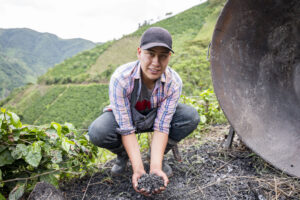
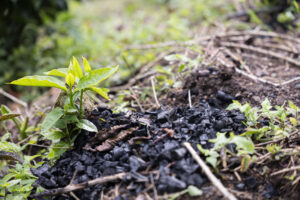
Equation Coffee is a Colombian specialty coffee exporter that works directly with more than 1,300 smallholder producers under a regenerative agriculture model. Together with agritech partner Cirkular Origin and field partner Biodiversal, Equation converts coffee prunings into biochar – a stable, charcoal-like product that improves soil fertility and water retention while sequestering carbon for a hundred years or more.
The Fund’s five-year loan, paired with technical assistance, will support the expansion of Equation’s biochar model across new producer clusters in the Huila and Tolima regions. The aim is to embed regenerative practices at scale, strengthen soil health and farmer income, and build the systems that allow Equation to access both premium markets and, where appropriate, carbon revenues.
The technical assistance focuses on areas where Equation is already well-positioned to lead: advancing MRV systems, soil organic carbon measurement, and a sustainability strategy that quantifies the co-benefits of biochar across soil fertility, micro-fauna, and water-related properties. For participating farmers, the return comes through premium payments for biochar-grown coffee and, over time, a share of carbon credit revenues – both tracked through Equation’s digital traceability platform.


Pilot 2 – Aldea Coffee, Nicaragua: coffee agroforestry
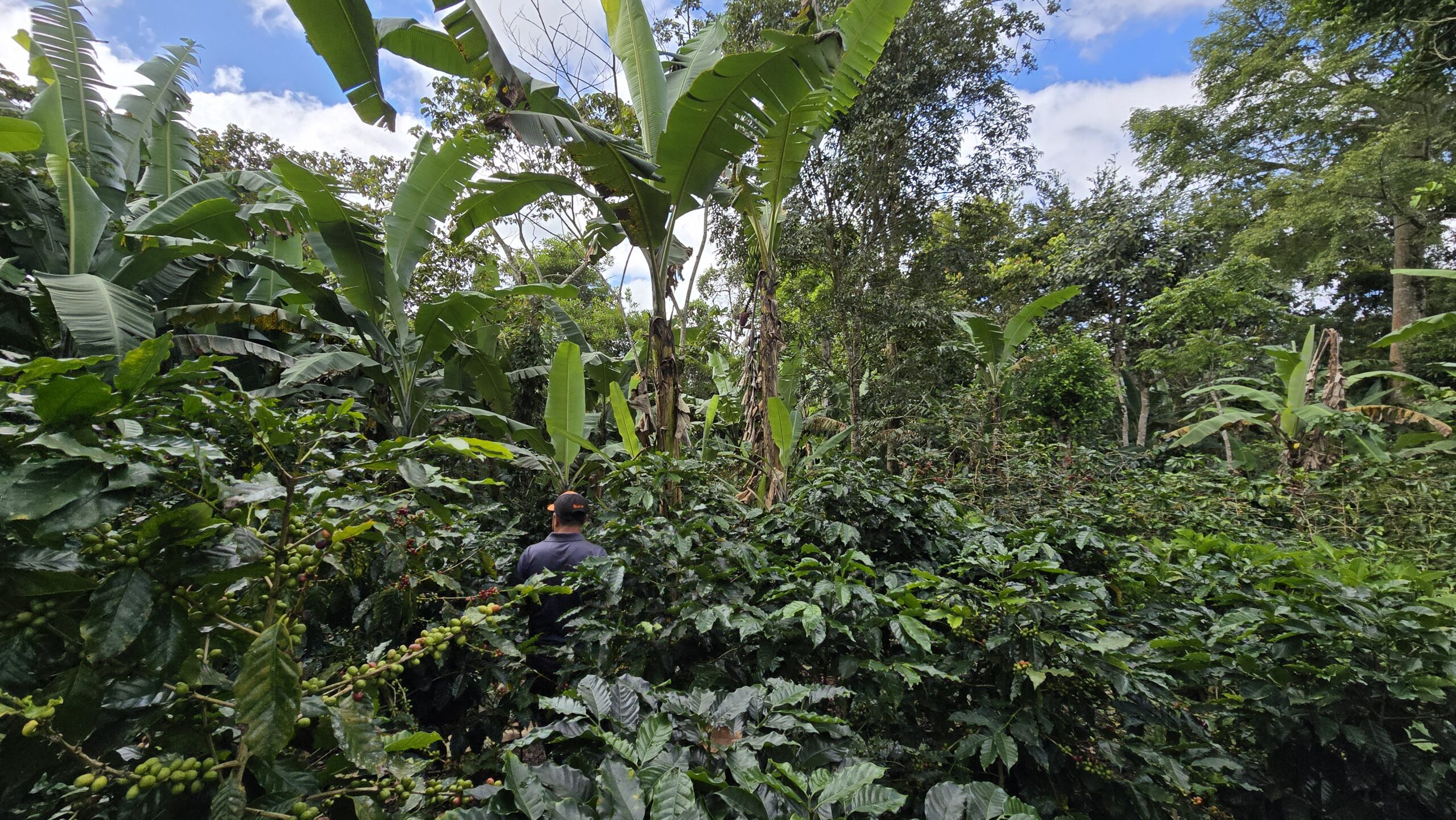
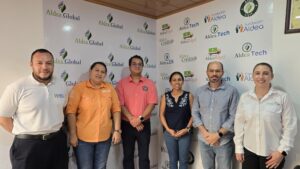
Aldea is one of the largest producer associations in Latin America, representing more than 20,000 smallholders across northern Nicaragua, of whom over 9,300 are coffee growers. Aldea is already enrolled in voluntary carbon markets through coffee agroforestry systems, with several years of operating experience and an established producer extension service. On average, each participating producer has earned roughly USD 400 in additional annual income – a meaningful margin on a smallholder budget.
The Fund’s six-year financing will help Aldea scale this model, supporting the maintenance, renovation and expansion of coffee agroforestry systems across Jinotega, Matagalpa, and surrounding regions. The ambition is to deepen the model: more producers, more hectares under agroforestry, and a broader set of sustainable practices including intercropping, forest preservation and soil testing – all delivered through the producer extension services Aldea has built over years.
The technical assistance with CGIAR is shaped around Aldea’s specific context. Aldea’s MRV systems are robust. The work focuses on strengthening carbon measurement methods and landscape-level biodiversity indicators on a pilot basis, building on existing data and producer surveys. That matters commercially as well as scientifically: high-end roasters and buyers are increasingly looking for credible biodiversity claims, and Aldea’s agroforestry landscapes are well-placed to supply them. Biodiversity credits, still an emerging market, sit on the horizon.



What comes next
These two pilots that took off in 2025 are a starting point. A broader pipeline of agri-SMEs and producer organisations is in development across Latin America, Africa and Asia, spanning different crops and taxonomy areas, and at varying levels of readiness for PES markets. Some will need deeper groundwork on MRV before the model can be applied. Others are sophisticated enough to move straight into advanced indicators and biodiversity work.
The ambition of CompensACTION is that, over time, smallholder farmers are fairly and routinely paid for both outcomes of their work: the produce, and the environmental value that comes with growing it well. PES cannot, on its own, close the living income gap. But combined with fair prices, sustainability premiums, and the certification systems that hold supply chains accountable, it adds a layer of income that has long gone unpaid.
Getting there requires patient capital, independent scientific research, and technical assistance that meets each partner where they are. It also requires the broader market – buyers, roasters, regulators, certifiers – to keep building the demand and the standards that turn those outcomes into income.
Equation and Aldea are the first two proof points. We’ll be sharing more as the projects progress.
CompensACTION is supported by BMZ and KfW. The Fairtrade Access Fund is advised by Incofin Investment Management.

Article by Shonan Kothari, Marketing and Communications Manager, Incofin Investment Management