
05.10.2026
- Impact Stories
How Namdev grew from a local to a national lender
This is an investment of the Incofin India Progress Fund-I. Our early backing helped Namdev Finvest expand from Rajasthan into ten Indian states.

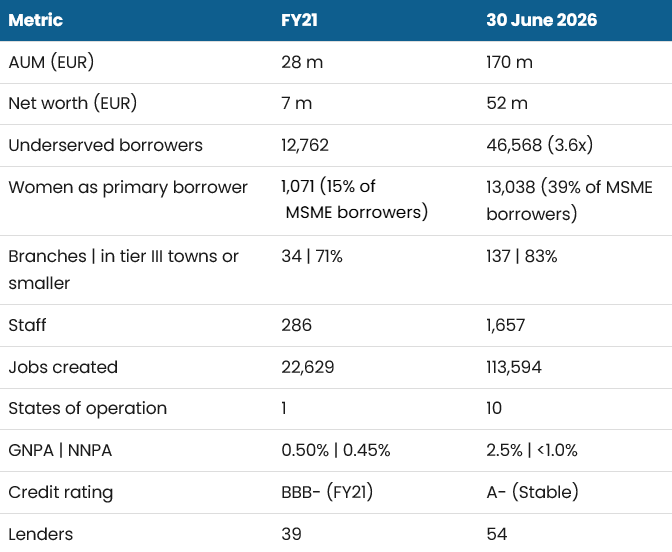
When Incofin invested in Namdev Finvest in September 2021, the company operated in one state, managed EUR 28 million in assets and served 12,762 underserved borrowers. In 2026, it has expanded across ten states, grown assets under management to EUR 170 million and is currently serving 46,568 underserved borrowers. Its credit rating had risen from BBB- to A-, while further institutional equity investors had joined Incofin on the shareholder register.
A founder who learned lending from the ground up
Most founders of Indian non-banking financial companies arrive in the business from a senior role at a bank. Jitendra Tanwar took a different route. He started working in 2006, at the age of seventeen, and learned about business in parts.
His first experience was in vehicle valuation and resale. He later worked as a direct selling agent for established financial institutions, sourcing customers and assessing loan applications, before gaining experience in collections. Together, those roles exposed him to judging asset quality, the full lending cycle and to customers whose businesses and incomes could not be understood through conventional documents alone.
By 2013, he was ready to build a lending company of his own. Rather than establish a new non-banking financial company from scratch, he acquired an existing licensed entity and began strengthening its documentation and operations. Eight years of measured growth in Rajasthan followed. By the time India Progress Fund invested in 2021, Namdev Finvest had developed a lending model grounded in local knowledge and disciplined underwriting. The next challenge was turning it into an institution capable of growing beyond its home state.
The customer Namdev was built for
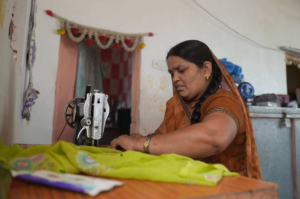
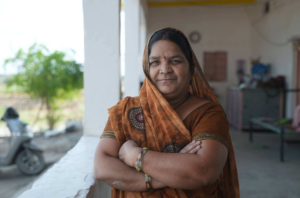
Namdev’s borrower is typically a micro-enterprise owner in a tier-three or tier-four Indian town: the kirana shopkeeper, the dairy farmer, the handloom weaver, the vegetable vendor, the agri-input dealer, the village pharmacist, often running the business from a property attached to or near their home. They earn somewhere between EUR 230 and EUR 750 a month. Around 15 per cent of Namdev’s customers have never borrowed formally before. The credit gap for this segment in India is large enough that the entire formal banking sector has, for the most part, declined to underwrite it.
These borrowers are underserved because the formal banking system is not always designed to evaluate their business properly. Their income may not come with salary slips, audited statements, or neatly prepared balance sheets; it may move through daily sales, seasonal cycles, and informal cash flows that require proximity and judgement to understand. For a metro-based bank branch, they have neither the local presence nor the patience to underwrite them properly. For Namdev, it is precisely where local presence becomes an advantage.
Namdev’s response is conservative for an Indian growth-stage NBFC. The MSME book, which is 95 per cent of everything the company lends, is fully secured, almost always against the borrower’s own residential or self-occupied commercial property. Loan-to-value is capped at 55 per cent, and the loan officer who visits the borrower is hired from the same locality. The reasoning: when the property securing the loan is the home where the borrower’s family lives, the borrower has every incentive to keep the loan current.
We give to those who are underserved by formal channels of credit, who typically own one property. That property is where their family lives, which makes the loan more secure.
 Jitendra TanwarManaging Director & Founder
The recent impact report tells one such story: a grocery shop owner in rural Rajasthan whose stock and sales were held back by a lack of space and working capital. A first loan from Namdev went into expanding the shop, adding inventory and refrigeration. A later top-up loan kept the business growing, which in turn stabilized the household and paid for better schooling for the owner’s child.
Physical first, then digital
Indian NBFC debate often frames lending as a choice between fully physical and fully digital. Namdev is neither. Every customer assessment begins in person. A local employee from the branch visits the borrower’s home and business, observes the family, evaluates the property, and forms a view of cash flow that no algorithm can produce from a phone. Once the customer is logged in, the digital journey takes over. Namdev has moved loan documentation almost entirely to e-signatures, with customers able to authenticate through face recognition, biometric verification, or Aadhaar-based authentication. The company sees this as a differentiator in a segment where lending still depends heavily on physical paperwork and branch-led processes.
When Incofin invested in September 2021, Namdev was operating in a single state – Rajasthan, the founder’s home state. It now has 135+ branches across ten states, with Odisha the newest, opened in July 2026 with five branches within a 250-kilometre radius of Bhubaneswar. Eighty-three per cent of branches are in tier-three towns or smaller. Rajasthan’s share of the book has come down from 95 per cent in FY22 to 66 per cent as of June 2026, with Gujarat, Madhya Pradesh and Uttar Pradesh now the other three core states; Punjab, Delhi, Haryana, Uttarakhand, Bihar and Odisha remain what the company calls learning geographies.
What five years of growth look like
The loan book has grown at roughly 50 per cent CAGR, from EUR 32 million at the end of FY22 to EUR 170 million in June 2026.
Asset quality and liability diversification are the two metrics lenders look at first, and both reflect where a secured, branch-led model earns its keep. Namdev’s rating has been upgraded four times, from BBB-minus in FY21 to A-minus this quarter, its average cost of borrowing has fallen significantly, and it now borrows from 54 lenders, a quarter of them international, including FMO, BlueOrchard, Symbiotics, Mirova and Incofin’s own funds.
Where Incofin came in
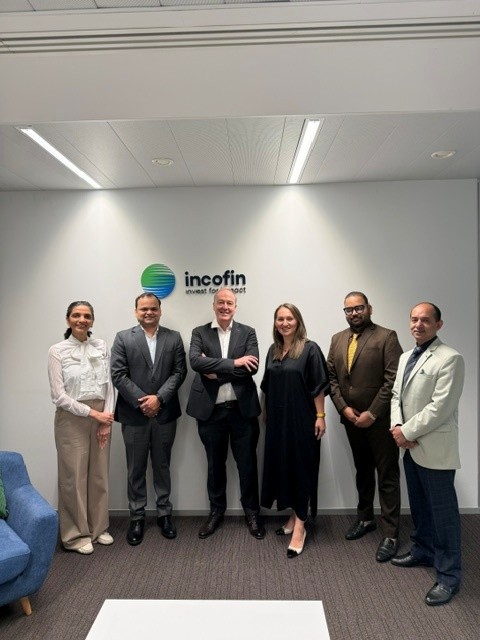
Jitendra is direct about Incofin’s role. Asked in Antwerp what changed after the September 2021 investment, his answer was almost verbatim:
“We are here today only because of Incofin.”
The substance underneath that line is worth unpacking. Incofin India Progress Fund was the first institutional equity investor on Namdev’s cap table. That first cheque is the hardest one for a tier-three town NBFC to land, because it requires an investor to look past the geography, the founder profile and the absence of marquee brands in the room and underwrite the business on its merits.
What followed was a sequence of further capital raises that would have been considerably harder to execute without that initial validation. British International Investment, Lighthouse Canton and Maj Invest followed Incofin onto the register. Since inception, Namdev has raised ~EUR 36 million of equity in four rounds, of which the promoter group itself invested in ~EUR 8 million. On a fully diluted basis as of June 2026, the promoter group holds 46 per cent, with the four institutional investors, employees and other holders sharing the rest.
The relationship has since widened. Namdev is now also a debt investee of the Global Gender-Smart Fund, for which Incofin acts as one of three portfolio managers.
“From Incofin’s side, Ritesh Modi helps a lot, in HR, in hiring, in equity & liability partners, in everything required for growth.” – Jitendra Tanwar
A team built
In 2021, when Incofin entered, the company did not have a chief human resources officer, a head of technology, a chief treasury officer, a head of legal and compliance. Gradually, all of these roles were filled with experienced hires from larger institutions, alongside two independent directors with ICICI, Axis and Bajaj Allianz pedigrees. Headcount has grown from around 300 at investment to 1,657. In March 2026, the company converted from a private to a public limited company, with listed debt, and now carries the compliance load that goes with that.
The other people number that matters is employee participation. In the company’s 2024 equity round, around eighty senior employees personally invested at market price, and the internal infusion of March 2026 was again funded by promoters and employee stock options. Namdev has held the Great Place to Work certification for three consecutive years.
The numbers
Between September 2021 and June 2026, the company grew roughly six-fold on assets under management, seven-fold on net worth and almost four-fold on active borrowers.
Women on the loan file
Every MSME loan Namdev writes has a woman on it: the company requires a woman as applicant or co-applicant on all of them. In 13,038 cases, 39 per cent of the MSME book, the woman is the primary borrower, meaning the business, and the cash-flow assessment are hers and the family’s, and in majority of the cases the property title as well. That is a high share for a fully secured product in a country where only a small minority of women hold property in their own name, and Namdev nudges it along: a woman entrepreneur borrowing in her own name pays one percentage point less in processing fee and fifty basis points less in interest.
The harder problem is on the payroll. Namdev’s Gender Action Plan 2024 to 2029, drawn up after a gender assessment when the Global Gender-Smart Fund came in, sets targets for women’s representation at three levels of the company. At head office and in senior management, the company reports women at over a third of the team. In the field, where loan and collection officers travel up to fifty kilometres a day in rural areas of India, the share is far lower, and the company is candid that safety is the constraint. Rather than pretend the field is solved, it has changed what it controls: marginally shorter working hours for women staff, menstrual leave, maternity and paternity leave, two-wheelers for top field performers, and a rule that where a woman candidate can do the job, she is hired over a man.
“Hiring for field roles remains challenging. In rural areas, field officers may travel long distances to source a file or collect repayments, and safety considerations naturally become more important. Wherever the role can be performed in a safer and more structured environment – such as call centres, in support functions, in credit, where it is a safer environment – we do.” – Namdev leadership, Antwerp, 16 September 2026
Looking ahead
Incofin’s own role is the one it has played since 2021: a seat on the board, support on governance and compliance as a company, help with senior hiring, and introducing equity & liability partners as the footprint grows.
“Namdev’s mission is to lend to people who are often outside the reach of banks and formal financial institutions, so that they can support their family, grow their businesses and create employment for a few more people along the way.” – Jitendra Tanwar, CEO & Founder, Namdev Finvest
That is the operating reality of every loan file Namdev underwrites. The collateral may be the borrower’s home, but the asset being financed is the borrower’s livelihood, and through it, the livelihood of the few employees, family members and downstream suppliers who depend on that one micro-enterprise.

This is an article by Shonan Kothari, Marketing and Communications Manager, Incofin Investment Management