
06.03.2026
- Impact Stories
She built her shop, her house, her future
International Women’s Day, 2026: How BRAC Liberia is supporting women to rewrite their own stories.
*This is an investment of the Agri-Finance Liquidity Facility.

Eva was eleven years old when she moved to the city to live with her aunt. She had been separated from her parents during Liberia’s civil war, raised by her grandmother in a rural farming community where opportunities were few and futures uncertain. Her aunt taught her how to trade. It was the most valuable education she would receive.
Years later, after her mother died and a robbery left her with nothing, Eva’s father gave her LRD 10,000 – about 53 US dollars- and told her to start again. She tried. But without access to capital, growing a small business felt like pushing against a wall.
In 2017, Eva took her first loan from BRAC Liberia Microfinance Company Limited (BLMCL): LRD 16,000, or roughly 85 US dollars. She invested it in a bale of used clothes and sold them in her community. Within a year, she had expanded into dry goods. Then into a proper shop. Loan by loan, her business grew. By September 2025, Eva received a loan of LRD 115,000 – 615 dollars – and today she owns her shop, pays her children’s school fees, and lives in the house she built with her own hands, now in its final stages of completion.
Eva’s story is extraordinary. It is also, in Liberia, remarkably common.

The country, the challenge, the stakes
Liberia is one of the poorest countries in the world. Nearly six in ten people live in poverty, with the burden falling heaviest on those in rural areas – and most heavily of all on women. Only around 9% of women in Liberia have an account with a bank or financial institution. For the majority, formal credit simply does not exist.
The food crisis compounds this. According to the UN Food and Agriculture Organization, 81% of Liberia’s population suffers from food insecurity and 38% are undernourished – among the highest rates on the continent.
This is the landscape in which BLMCL operates. Launched in 2008, BLMCL has grown into the largest microfinance institution in the country, serving over 124,000 clients across all 15 counties – 96% of them women. Reaching them is not straightforward. Good roads are scarce. The rainy season makes remote communities near-impossible to access. And yet BLMCL’s frontline staff show up anyway, navigating the terrain because the women waiting at the end of those roads have nowhere else to turn.
CEO Dyson Mandivenga, who leads BLMCL, puts it plainly: ‘Despite being the largest Microfinance Institution in the country, we are only supporting a fraction of the people who need our support.’
More than a loan
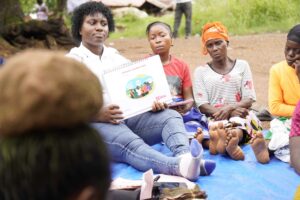
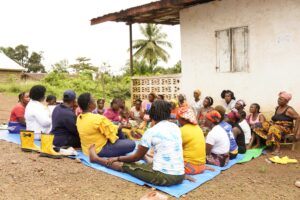
What BLMCL offers goes well beyond credit. Financial, digital, and life skills training (FLT) – covering budgeting, record-keeping, business decision-making, nutrition, and household planning – is how the institution works.
This is not a passive session. FLT happens in the group and is designed to sensitise clients on their rights and responsibilities, responsible borrowing practices, and basic financial planning – building capability alongside capital.
The impact is measurable: clients who receive this training demonstrate stronger financial resilience and higher quality of life, with particularly pronounced effects among women aged 18 to 35.
A 2024 survey by impact measurement firm 60 Decibels found that 88% of BLMCL clients reported that loan repayments were not a burden, and 75% said they would struggle to find a suitable alternative – showing the institution’s critical and largely irreplaceable role in these communities.
Then there is AIM – the Mastercard Foundation’s Accelerating Impact for Young Women programme, implemented jointly by BRAC’s microfinance and NGO entities across seven African countries. AIM combines FLT, social empowerment, with access to income-generating assets for participants: farm animals, tailoring machines, start-up capital. Women who complete the two-year programme can then access BLMCL loans to grow their businesses further.
The results extend beyond income. Many AIM participants report stronger self-confidence, greater agency in household decisions, and deeper engagement in their communities. When women gain economic power, it ripples outward – into families, into villages, into the next generation.

Liberia: the agrifinance opportunity
There is an irony related to Liberian food security: the country is an agricultural economy that imports staples like rice. More than half of people living in poverty depend on farming for their livelihoods – and yet most financial products are not designed with women smallholders in mind. Their demand for credit goes unmet, season after season.
The vulnerability is structural. Liberia ranks 174th out of 182 countries on the Notre Dame Global Adaptation Initiative (ND-GAIN) index, which measures a country’s exposure to climate change against its capacity to adapt. The World Bank’s 2024 Country Climate and Development Report warns that without action, Liberia could lose up to 15% of GDP by 2050, with a further 1.3 million people pushed into poverty.
Liberia’s authorities are beginning to respond. In June 2025, the Central Bank of Liberia (CBL), with World Bank support, validated a national roadmap to integrate climate risks into the financial sector – introducing climate stress testing for banks, a national green taxonomy, and incentives for green finance products. It is a meaningful step. But for the smallholder women farming Liberia’s land today, the gap between policy and protection remains vast. Closing it requires capital that reaches the last mile now.
Since 2022, BLMCL has been working to change this. Its agrifinance loans are specifically designed for women smallholder farmers: collateral-free, with grace periods and flexible repayment terms aligned to harvesting cycles. By the end of 2025, BLMCL had provided agrifinance loans to more than 19,000 borrowers, totalling USD 9.9 million in disbursements since the programme’s inception.
The clients it reaches are among the most financially excluded on earth. 75% live below the USD 3.20 per day poverty line. 94% are accessing a loan for the first time. And climate is an ever-present threat: floods, dry spells, and erratic seasons batter smallholders who have the least capacity to absorb shocks.
The data shows that access to credit is changing this situation. Over 50% of agrifinance clients reported that the negative impact of climate shocks on their households was less severe because of their BLMCL loan, which allowed them to adapt. 88% said their farming practices had improved after working with BLMCL.
This work is supported by our Agri-Finance Liquidity Facility (ALF), a fund initiated by KfW and Germany’s Federal Ministry for Economic Cooperation and Development (BMZ) and managed by Incofin. Designed to strengthen food security and enable climate adaptation in agricultural communities across Africa and Latin America, the ALF provides the kind of patient, crisis-resilient capital that institutions like BLMCL need to serve clients at the frontier of financial exclusion – and at the frontline of climate vulnerability. BLMCL represents exactly the kind of investee the fund was designed to sustain.


Technology reaching the last mile
Delivering financial services in Liberia has historically meant paperwork, travel, and time – none of which rural women have in abundance. BLMCL’s recent technological upgrades are beginning to change this.
The implementation of a core banking system (Temenos T24) now enables real-time reporting and faster decision-making for staff. A Digital Field Application has reduced the time spent on group meetings and paper-based transactions. For a client in a remote village, this means she can check her loan balance and installment schedule during a group meeting – without travelling to a branch – and get back to her farm or her shop faster than before.
It is a small shift that, multiplied across 124,000 clients, makes something significant: time returned to women who have never had enough of it.
What Incofin’s presence means
Incofin is one of a small number of investors making direct investments in Liberia – a market most international capital bypasses entirely.
‘With your support, we are able to reach thousands of women with access to responsible financial services who would otherwise be left out, and we are seeing measurable improvements in their lives,’ Dyson says. ‘We expect this partnership to grow stronger and help attract other impact investors to the market, enabling us to secure the resources needed to grow.’
The ambition is clear: to make the market legible to other investors - and to show that responsible capital can reach last‑mile communities, even in one of the world’s most challenging operating environments.
 Federica MalfaSenior Investment Manager, Debt Financial Institutions Africa, Incofin
98%. 95%. 124,000.
Numbers have a way of becoming abstract. But behind BLMCL’s statistics are women like Eva – women who have rebuilt their lives from nothing, who are putting their children through school, who are constructing homes with their own earnings. BLMCL’s annual impact surveys with 60 Decibels found that in 2024, 98% of surveyed clients reported an improvement in their quality of life and income. 95% said they were able to save more.
Their businesses span the breadth of informal economic life: fruits and vegetables, dry goods, food catering, beauty salons, small-scale manufacturing of everyday essentials like soap and oils.
On International Women’s Day, it is worth pausing on what this means: that across 55 branches, in all 15 counties of a country still healing from war and poverty, women are building.
Eva’s house is almost finished.






BRAC Liberia Microfinance Company Limited (BLMCL) is supported by the Incofin-managed Agri-Finance Liquidity Facility, backed by KfW and Germany’s Federal Ministry for Economic Cooperation and Development (BMZ).
Photo credit: Tahjib Shamsuddin, BRAC International

Article by Shonan Kothari, Marketing and Communications Manager, Incofin Investment Management