
09.04.2026
- Impact Stories
When farmers own the company: The Sahyadri Farms story
An interview with Vilas Shinde, Founder, Chairperson and Managing Director of Sahyadri Farms – India’s largest farmer-owned horticulture enterprise. Sahyadri is a portfolio company of the Incofin India Progress Fund I.

Somewhere between a two-acre vineyard in Nashik and a supermarket shelf in Rotterdam, something structurally impossible is happening – and happening at scale.
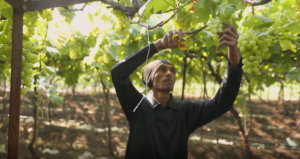
Grapes grown by Indian smallholder farmers, most of them cultivating less than two acres, are arriving in premium European retail chains, meeting the same quality and traceability standards as produce from the world’s most industrialized farms. Behind this is Sahyadri Farms: a company majority owned by its farmers, built on the conviction that collective action can turn subsistence agriculture into a globally competitive business.
We sat down with Vilas Shinde – the founder who shares his journey of debt, partnership, and a shipment of grapes that got rejected in the Netherlands – to understand how Sahyadri grew into a nearly INR 2,500 crore (EUR 230 million) enterprise, what Incofin’s role has been in that growth, and what comes next.
The origin – “As a small farmer, farming is a loss-making activity.”
Vilas Shinde did not set out to build India’s largest farmer producer company. He simply set out to survive.
He grew up in a joint family, among six siblings, each of whom had two acres of land in Nashik, Maharashtra. He was driven, and his family wanted him to study, venture out, and get a job. But he wanted to farm, so he trained as an agricultural engineer. In the early 2000s, he tried his hand at everything – commercial crops, dairy operations, vermicompost production. None of it worked. By the time he was 25, he had accumulated INR 75 lakh (EUR 140,000) in debt.
“As a small farmer, farming is a loss-making activity,” he says. “The question was: how to make it profitable? On one side, you cannot increase the land size – land fragmentation is happening, people depending on farming is increasing. So another route is to bring people together, increase the land parcel, and create efficiencies.”
In 2004, he convinced nine other farmers from his village and neighbouring areas to pool their grape harvests and export directly to the Netherlands. The first shipments failed.
The first container was scheduled to arrive on 8 March. On the 9th, an email arrived: the quality wasn’t up to standard. The buyer refused the next three containers. The group was left with losses and debt. Vilas had never been abroad, but he flew to the Netherlands to see for himself – his first trip, visa obtained the day before, travelling to Mumbai by hitching a ride on a truck at 4am. He discovered the market had crashed and the buyer had transferred the losses onto them. The shipment was a write-off. Shinde sold his own land to repay the farmers – a decision that nearly ended his career but ultimately defined his leadership.
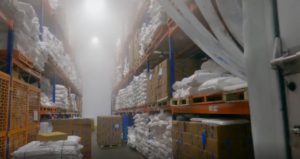
The failures taught him something critical: individual farmers could not meet the quality, safety, and traceability standards that premium markets demand. Only a collective could build the infrastructure – cold chains, packhouses, residue testing labs, digital traceability – that global buyers require.
“We kept learning and improving ourselves at every level,” he says. “At the farm level, at the packhouse level. And that gave confidence that as a small farmer, if you come together, you can create a standard that attracts global players – and then you can also get the premium.”
What began in 2004 as an experiment among 10 grape farmers had, by the time the company was formally registered in 2011, grown to 110. Sahyadri, a Farmers Producer Company, was born. Revenue in those early years was modest, but the model was taking shape.

The model – Building the “Amul of horticulture”
Vilas shares his inspiration: Dr. Verghese Kurien and the Amul cooperative that transformed India’s dairy sector.
“Milk and horticulture are two different commodities,” he says. “In horticulture, products are perishable like milk, but they are seasonal. If you are making any business with a seasonal crop, out of 365 days, you will work for 60 days. The remaining 300 days, your infrastructure, your labour, your resources – everything will remain idle.”
The solution was multi-crop integration. Rather than depending on grapes alone, Sahyadri brought together farmers growing eight different crops – grapes, pomegranates, bananas, mangoes, citrus, cashew, tomatoes, and sweetcorn – each with different harvest seasons. This meant year-round utilization of processing infrastructure and diversified risk at both the company and farm level.
“Our farmers are not dependent on one crop,” Vilas explains. “There are options now for them, and all options have the same ecosystem of support.”
What Vilas did borrow from Amul was the culture: professional management, ethical governance, transparency. Today, Sahyadri’s 22,500 farmer-members collectively hold a majority of the equity, each with voting rights.

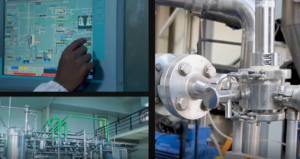
The company has also built a technology backbone that would be unusual even for a large commercial agricultural enterprise. Through digital platforms – FarmSetu for crop advisory and Vesatogo for supply chain traceability – and a network of IoT sensors and automatic weather stations deployed across member farms, Sahyadri tracks produce from sowing to shelf.
“Technology is a real game changer,” says Vilas. “But independently, a technology startup in agriculture finds it very difficult to survive. With the collaborative approach – the collective providing the scale, the startup providing the solution – that is the way forward for Indian agriculture.”

A turning point that “opens the way for all cooperative organizations”
By 2021, Sahyadri had grown to approximately INR 740 crore (EUR 68 million) in revenue on its own capital and internal resources. But Vilas recognized that the next orbit of growth would require institutional investment and external expertise.
The problem was structural. As a farmer producer company, Sahyadri could not bring in private equity investors. The solution – creating a subsidiary public limited company through the National Company Law Tribunal, then demerging the post-harvest business into it – had never been done in India.
“It took almost two years,” Vilas says. “But when it opened, it opened the way for all cooperative organizations. I think it is a big milestone for overall Indian agriculture.”
In 2022, Sahyadri Farms Post Harvest Care Limited raised INR 310 crore from a consortium of impact-focused investors led by Incofin, alongside Korys, Proparco, and FMO. It was the first time a farmer-owned company in India had raised private equity capital.
The partnership – “Incofin is the major instrument for us”
For Vilas, the choice of investor was as important as the capital itself.
“My personal thought was very clear,” he says. “Philosophically, we should have alignment with our investors – investors who are looking for social impact and who have a clear value system like us. They should come on board.”
He describes meeting Rahul Rai, Managing Partner at Incofin India, well before the formal fundraising process began. “During that meeting itself, I got this feeling that these are the right persons who understand our pain points, who understand the basic Indian agriculture problems, and who see where the solution is. There was a clear alignment.”
Since the investment, Incofin has played a role that extends well beyond the equity ticket. Rahul Rai sits on the board and is actively involved in strategic discussions – from corporate direction and cash flow management to advising on the investor composition for Sahyadri’s subsequent funding rounds.
“Whenever there are complicated situations, we always prefer to discuss with Rahul first,” Shinde says. “Incofin is playing a very active role in Sahyadri’s journey – on strategy, on further investment, and on day-to-day things.”
The partnership has also generated tangible technical support. Incofin introduced Sahyadri to British International Investment (BII) for a technical assistance project exploring microalgae-based effluent treatment – a first-of-its-kind initiative in India. The project treats wastewater through microalgae cultivation, then converts the biomass into bio-stimulants for agricultural use. After three years of validation, the resulting chlorella-based product recently received government gazette approval.
“This is the first of its kind in the country,” says Vilas. “But because of Sahyadri’s data and validation, now at least 10 such projects will come in India in the next two years.”
Through Incofin’s network, Sahyadri has also connected with agritech companies and other partners, strengthening the broader innovation ecosystem around the company.
The capital multiplier effect has been significant. Incofin’s lead investment was of INR 67 crore (EUR 8 million). It created an investor consortium with Proparco, FMO & Korys, enabling the closure of the INR 310 crore investment round in 2022. In December 2024, a second round of INR 390 crore followed from responsAbility and GEF Capital Partners, with all existing investors participating. Total institutional capital raised: approximately INR 700 crore – a 10x multiplier on Incofin’s original ticket.
Asked whether he would recommend Incofin to other agricultural entrepreneurs, Vilas says: “Definitely. Compared to any other investor I have met, Incofin is always a better option for Indian agriculture startups. They have a deep understanding of the local situation. They understand the agri-food sector in a better way.”
Sahyadri has become a reference point in the agriculture & food sector in India. It demonstrates how a world-class organisation can be created in India for the world. It brings together entrepreneurial farmers and provides them with complete ecosystem solutions, including market access, cutting-edge biotechnology, and digital technology. This unique business model is thanks to the vision of Vilas Shinde. I am confident that not only will Sahyadri Farm’s footprint increase significantly from here, but it will also create a long-lasting impact on the entire system, which will inspire other budding rural entrepreneurs.
 Rahul RaiManaging Partner, Incofin India
Impact: “My parents never imagined their son’s produce would travel abroad”
Sahyadri’s story proves: farming can be profitable and dignified for smallholders.
The economic impact for member farmers has been substantial. Sahyadri provides stable, predictable pricing and payment cycles – replacing the volatility of mandi trading – and gives farmers access to premium export markets they could never reach individually.
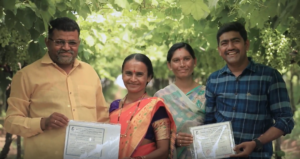
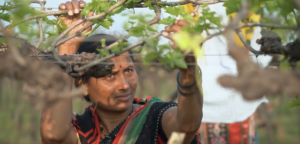
Behind the aggregate numbers are individual stories.

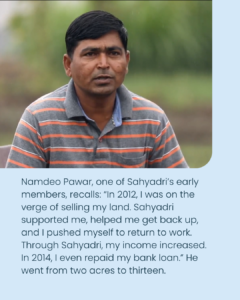

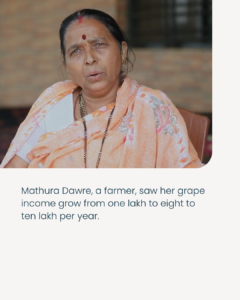
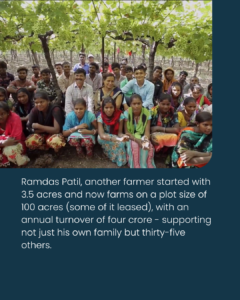

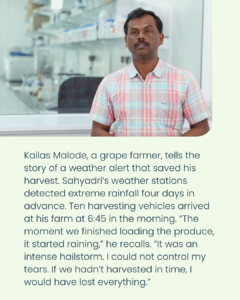


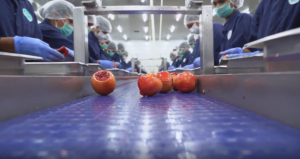
The impact extends into formal employment, particularly for women. Sahyadri’s processing facilities – where fruit is sorted, graded, packed, frozen, and converted into products ranging from fresh and frozen produce to nutraceutical extracts – employ thousands of people, a significant proportion of them women, in a region where formal rural employment for women is scarce.
Sahyadri is also deeply involved in the Farmer Cup, in partnership with the Paani Foundation. This is a collective farming competition across Maharashtra. Vilas Shinde sits on the state-level committee overseeing the initiative’s expansion.
The competition has grown rapidly – from 1,500 farmer groups in its first year to 4,500 in its third, with 20,000 groups expected in 2026.
“Farming is a business,” Vilas says. “We are giving everybody this thought: you need to think like a professional. How can we make farming a profitable business, without any charity, without any support? For that, the collective is a must.”





What comes next
Sahyadri is now preparing for what would be the most significant milestone in its history: a public listing on the Indian stock exchanges. Vilas confirms the company plans to pursue an IPO within the next three years – which would make Sahyadri the first farmer-owned company to be publicly listed in India.
“No Indian farmer has seen this dream,” he says. “That this type of model will evolve, and that they will have the opportunity to go in the share market as a shareholder of the company. After the IPO, there will be a completely new world for Indian agriculture – because capital can be attracted, and along with capital, talent will be attracted.”
The growth trajectory supports this ambition. With a turnover of nearly INR 2,500 crore in FY26, Sahyadri is targeting new plans. It is expanding into new crops – ginger, turmeric, and chili – and new geographies across at least half of India’s states, with plans to add pineapple from the northeast, apple from the north, and coconut from the south.
On the consumer front, The Juice Farm – Sahyadri’s B2C franchise model offering fresh fruit juices from frozen produce – has grown to 68 stores across Maharashtra and Gujarat.
Sahyadri’s bioactives division is also extracting nutraceutical compounds from fruit waste – pomegranate peels, grape seeds, and other processing byproducts that were previously discarded – turning what was once farm waste into a growing revenue stream.
For Incofin, Sahyadri represents something larger than a successful portfolio investment. It validates the thesis that patient capital, active engagement, and philosophical alignment with founders can accelerate inclusive growth at a structural level – transforming not just one company, but the operating model for an entire sector.
As Incofin prepares to launch its India Progress Fund II in 2026, the Sahyadri story is both proof of concept and compass: evidence that when you back the right entrepreneurs with the right model, the impact compounds – from 10 farmers sharing a rejected shipment of grapes to 22,500 farmer-owners – and over 30000+ registered farmers – who are building the future of Indian agriculture.

Article by Shonan Kothari, Marketing and Communications Manager, Incofin Investment Management